
EVGENY KHALDEI
(NAMED EFIM AT BIRTH)
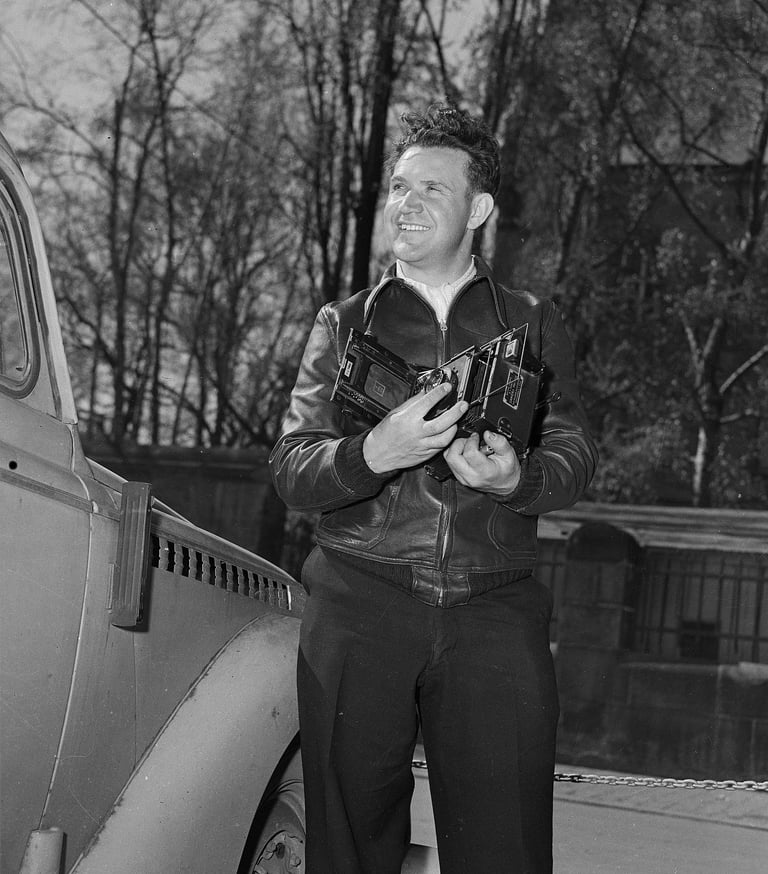
Evgeny Khaldei (1917–1997) was a major figure in twentieth-century photojournalism, whose work shaped the visual memory of the Second World War and its aftermath.
Born in Yuzivka (now Donetsk, Ukraine), and named Efim at birth, he began photographing as a teenager. His early photographs of workers and everyday life were published in the national press, and in 1936 he began working for TASS, the country’s principal news agency.
Khaldei’s biography was inseparable from the upheavals of the century he would later photograph. His mother was killed during an anti-Jewish pogrom while shielding him with her body; Khaldei survived, wounded, and was raised by his grandparents. During the Second World War, members of his family were murdered by the Nazis. These facts do not define his work in a single biographical key, but they form part of the historical reality through which his camera would later move.
During the war, Khaldei worked across decisive stages of the conflict, photographing frontline events, liberated cities, displaced civilians, and the devastation left behind. He is widely known for Raising a Flag over the Reichstag, photographed in Berlin on May 2, 1945 — one of the most recognisable images of the Second World War. Yet his work extends far beyond this single photograph. Khaldei photographed not only victory and destruction, but also exhaustion, return, civilian life, and the fragile emergence of a postwar world.
In 1945–46, Khaldei photographed Europe in the immediate aftermath of war, including Vienna, Budapest, Berlin, and the Nuremberg Trials. At Nuremberg, three of his wartime
photographs were presented as evidence of Nazi crimes. He also photographed the proceedings themselves, recording the courtroom in which the crimes of the Nazi regime were named, examined, and brought to judgement. His Nuremberg images stand at the intersection of photojournalism, documentation, and legal history.
Khaldei’s photographs combine the urgency of reportage with remarkable visual precision. He worked with the attention of a photojournalist and the sensibility of an artist, shaping images in which history appears through people, gestures, streets, ruins, and moments of everyday life. He photographed life under the pressure of history — public and private, tragic and ordinary, damaged and joyful, violent and tender.
In 1948, Khaldei was dismissed from TASS during the anti-cosmopolitan (anti-intelligentsia) campaign. He continued to work for newspapers and magazines, producing photographic reports on industry, public events, everyday life, and the memory of the war.
From the 1990s, his work received wide international recognition through exhibitions in Europe and the United States.
Today, his photographs remain not only records of historical events, but enduring images of the twentieth century as it was lived, witnessed, and remembered.
18 - 27 June 2026
Kramer Gallery
Bösendorferstraße 4
1010, Vienna
Opening Hours
Mo - Sa
12:00 - 18:00
© 2026. All rights reserved.
Further information on the collection: vlevin.co.uk & v.o.levin@gmail.com