
ABOUT THE EXHIBITION
Beyond Nuremberg: The Camera as Witness presents photographs by Evgeny Khaldei (1917–1997), a major figure in twentieth-century photojournalism. The exhibition focuses on Khaldei’s Europe of 1945–46 — a moment between the final stages of the Second World War and the beginning of its aftermath, when history was still unfolding in cities, streets, courtrooms, and civilian lives.
The title Beyond Nuremberg points in two directions. It refers to Khaldei’s rarely exhibited photographs of the Nuremberg Trials, where photography entered the space of evidence and became part of the historical and legal reckoning with the crimes of the Nazi regime. At the same time, it looks beyond the courtroom, toward the wider geography of postwar Europe: Vienna, Berlin, Budapest, and later images of peacetime life, where the traces of war appear through damaged buildings, displaced people, survivors, public spaces, and the fragile return of everyday life.
At the centre of the exhibition are two thematic axes: Cities, Survivors, Civilian Life and Aftermath: The Camera as Evidence. The first brings together Khaldei’s photographs of Vienna in the days of liberation and its immediate aftermath with works from Berlin and Budapest. Seen today in Vienna, these images create a direct connection between the historical city Khaldei photographed and the place in which the exhibition is presented. They show liberation not as a single triumphant image, but as a complex condition: marked by destruction, exhaustion, movement, and the first signs of daily life beginning again.
The second axis, Aftermath: The Camera as Evidence, is dedicated to Khaldei’s Nuremberg photographs. In the 80th anniversary year of the conclusion of the Nuremberg Trials, these works take on particular resonance. At Nuremberg, three of Khaldei’s wartime photographs were presented as evidence of Nazi crimes. He also photographed the proceedings themselves, recording the courtroom in which the violence he had witnessed across Europe was named, examined, and brought to judgement. Here, the camera is not only a tool of record, but part of the process through which history is made visible, questioned, and judged.
The exhibition also asks how such photographic witnesses are preserved and returned to view. At the foundation of the project is the сollection of Vadim Levin — photographer, collector, author, and researcher, whose long-standing engagement with Khaldei’s legacy has made the exhibition possible. More than a source of rare prints and archival materials, the сollection is an act of care toward the photographic memory of the twentieth century. Alongside original prints by Khaldei, the exhibition presents gelatin silver prints made by Levin from Khaldei’s preserved original negatives — a continuation, in another time, of the darkroom attention that was central to Khaldei’s practice.
Seen together, these works offer a view of history not as a completed narrative, but as something still being witnessed, recorded, preserved, and returned to the present.
PARTNERS

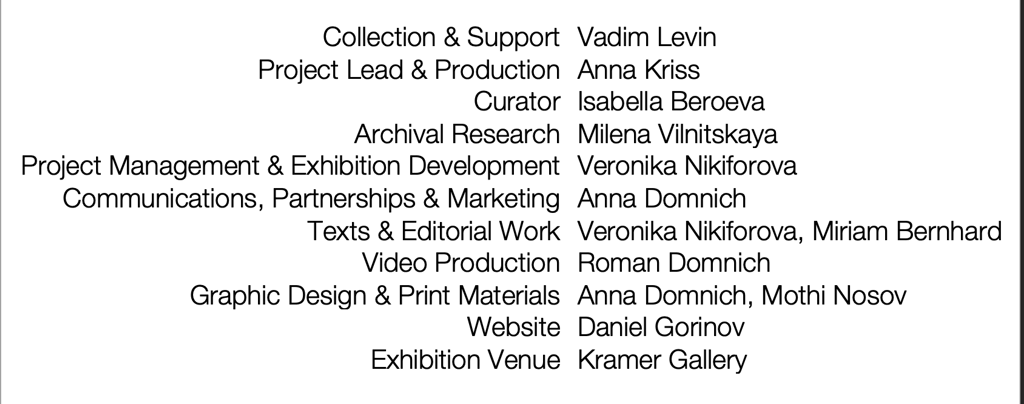
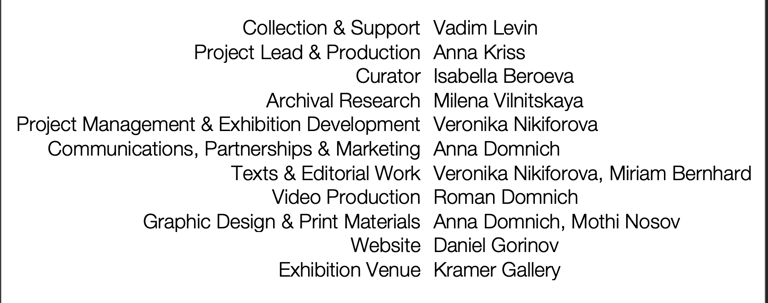
PROJECT TEAM
18 - 27 June 2026
Kramer Gallery
Bösendorferstraße 4
1010, Vienna
Opening Hours
Mo - Sa
12:00 - 18:00
© 2026. All rights reserved.
Further information on the collection: vlevin.co.uk & v.o.levin@gmail.com