
For half a century, this photograph remained unseen – not a single exhibition would take it. “I tried to offer it,” recalled Soviet photographer Yevgeny Khaldei. “But for 50 years, it went nowhere. Then, for the 50th anniversary of Victory, it was printed in the United States. And here – still silence. They don’t want it.” Khaldei shared this memory in a 1996 documentary by Belgian filmmaker Mark Henri Weinberg.
The image in question was taken in Budapest, shortly after Soviet troops liberated the city in early 1945. What Khaldei encountered there left a deep scar on his soul. Amid the devastation, he came upon a synagogue filled with the unburied bodies of murdered Jews. The horror was still fresh, the silence oppressive.
And then he saw them — a man and a woman walking side by side, marked by the yellow six-pointed stars sewn onto their clothes. The ghetto had been liberated, yet they still wore the badges forced upon them by their tormentors. Khaldei, himself Jewish, was shaken by the sight.
He approached with his camera. But he wore a leather coat – the kind favoured by German SS officers. The couple recoiled in fear, mistaking him for a Nazi. Realising their terror, Khaldei called out in Yiddish – “Wait!” — as he drew closer. Gently, he tore the star from the man’s coat, then from the woman’s. Still frightened, they didn’t understand.
“Alles ist gut,” he told them. Everything is fine. But that wasn’t enough. They needed something more – a word, a sign that he was one of them. And then he said it: “Shalom Aleichem.”
At those words, the tension broke. They burst into tears and collapsed into the arms of the photographer.
It was a moment of human connection amidst the ruins – captured in a photograph that for decades no one wanted to see in the Soviet Union.
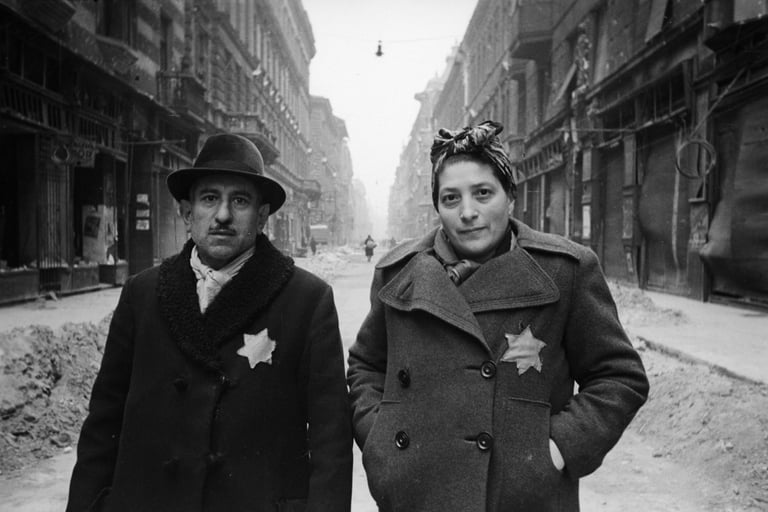
Evgeny Khaldei. Budapest. Family, Liberated, February, 1945 Budapest, Hungary
18 - 27 June 2026
Kramer Gallery
Bösendorferstraße 4
1010, Vienna
Opening Hours
Mo - Sa
12:00 - 18:00
© 2026. All rights reserved.
Further information on the collection: vlevin.co.uk & v.o.levin@gmail.com