
April 1945, Berlin. German Women on the Streets of Berlin - photographed by Yevgeny Khaldei
“At last - Berlin.” So recalled Yevgeny Khaldei, the renowned Soviet war photojournalist who had accompanied the Red Army from Murmansk to the very heart of Hitler’s Germany. In those final days of the war, Khaldei advanced towards the centre of the devastated capital alongside the soldiers of General Vasily Chuikov’s 8th Guards Army. The streets were blanketed in dust and debris; the acrid smoke bellowed from shattered windows. In the echoing silence the clatter of tank tracks sounded - Soviet tanks rolled forward in unbroken steam heading towards the Reichstag.
Suddenly, a scene unfolded that Khaldei would remember for the rest of his life. From the entrance of a ruined underground station - now repurposed as a bomb shelter - a small group of women emerged. They appeared exhausted, dishevelled, and visibly shaken. One woman, barefoot, held a pair of shoes in her hands. Another clutched what she clearly regarded as a treasured possession: the pelt of a red fox - a vestige of a life that once was, of a world now lost.
They froze at the sight of the tanks, seemingly unable to believe what they were witnessing. One of them, her voice laden with fear and disbelief, asked in broken Russian or German:
— “What tanks are these? Whose?”
Still gripping his camera, Khaldei answered without hesitation:
— “Soviet tanks. Russian.”
The woman holding her shoes shook her head slowly, as though confronted by something inconceivable.
— “That cannot be…” she murmured. “We have been hiding in the shelter for days, listening to the radio. Goebbels said the Russians would never enter Berlin…”
In that moment, the false assurances of propaganda gave way to the reality of history. The world as she had known it had collapsed.
It was precisely this collapse - this instant of human vulnerability, disillusionment, and recognition - that Khaldei would carry with him. He captured not only the monumental events of victory, but also these quiet, poignant moments in which history revealed its most human face. For the true record of war is written not only in parades and surrender documents, but in fleeting encounters such as this - intimate, fragile, and profoundly real.
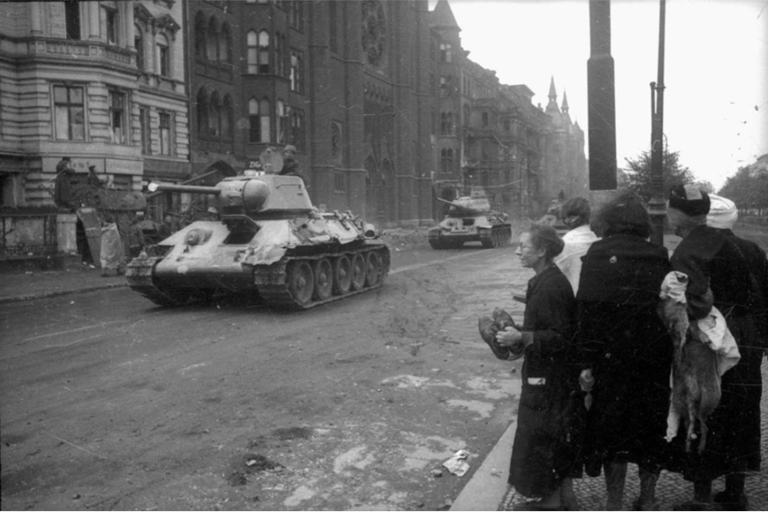
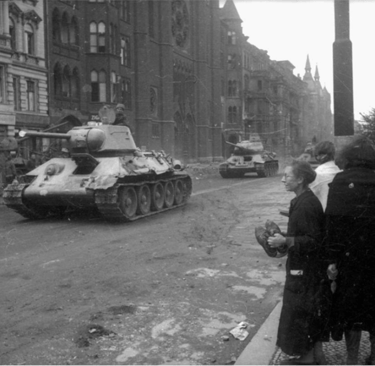
Evgeny Khaldei. Berlin. Woman with boots, 1945 Berlin, Germany
18 - 27 June 2026
Kramer Gallery
Bösendorferstraße 4
1010, Vienna
Opening Hours
Mo - Sa
12:00 - 18:00
© 2026. All rights reserved.
Further information on the collection: vlevin.co.uk & v.o.levin@gmail.com